The data is there.
In the ERP there are the transactions.
In the CRM, the pipeline.
In the spreadsheets for each department, the numbers that someone built last Friday for the next meeting.
The problem is not the lack of data: it's that they are distributed in five different systems, in three different formats, with two different definitions of what counts as “closed sale”.
And no one has time to cross them before the decision is already made.
Only 33% of organizations describe themselves as genuinely data-driven. [1]
65% use data to justify decisions already made—not to guide them—according to Gartner. [2]
This is not a problem of culture or training.
It's an architectural problem.
The data exists, but it's not where the decision maker needs it, when they need it, or in the format that allows them to act.
This article describes the three levels of reporting maturity in medium-sized Spanish companies and what separates each one from the next.
There are no magic tools in the process: there are design decisions that are made... or not.
Data exists within the company, but it rarely arrives on time
65% of ERP users consider it difficult to access their own data. [3] Only 23% have real-time information, and only 11% believe that their system captures all the non-financial information needed to track their operational KPIs. [9]
These numbers are not anecdotal. They describe a structural pattern.
The ERP was designed to record transactions, not to serve information to decision makers. It's optimized to ensure that the data fits — that the invoice is correct, that the stock is up to date, that the accounting entry closes — not so that that data can be easily explored.
Therefore, something apparently simple, such as analyzing sales by category, channel and margin, with historical comparison, becomes a technical process: locating tables, applying filters, exporting without losing structure.
The outcome is predictable.
Data doesn't flow: it's extracted.
Someone on the team accesses the ERP, exports the information, crosses it with CRM data and manually reconstructs the vision that direction needs. According to FSN Research, financial teams spend between 80 and 120 hours a month on these types of tasks. [5]
That is, between one and three full weeks of work aimed at producing information that, in theory, already exists.
McKinsey estimates that employees waste 9 to 10 hours a week searching for information and coordinating to obtain it. [11] And nearly half of that time could be eliminated with an appropriate data architecture.
Because the problem isn't the amount of data.
87% of the least mature companies have access to the same types of data as the more advanced ones. [8]
The difference is in the speed with which they can use them.
And in the decisions that that speed allows — or prevents — from making.
The three reporting maturity models in a midsize company
The transition from “the data is in Excel” to “the data guides decisions in real time” doesn't happen all at once. It is a progressive evolution, with three clear levels of maturity that mark how a company uses — or wastes — its information.
Level 1. Manual and reactive: reporting as a cost of coordination
At the first level, reporting is manual and reactive. This is where most medium-sized Spanish companies operate. [6] Information exists, but it is generated on demand: someone asks for a report, someone builds it by extracting data from different systems, and the result comes hours or days later. By then, it's starting to be out of date.
The cost of this model does not appear as a specific item, but it is real: hours of the financial team, the controller or the analyst dedicated to reconstructing the same information over and over again. IDC estimates that organizations with siloed data lose between 20% and 30% of their productivity due to inefficiencies. [7] Manual reporting is one of the main mechanisms that generate them.
Level 2. Automated and departmental: dashboards that reduce cost but don't change culture
At the second level, reporting is automated. Tools such as Power BI or Tableau appear, reports are updated in real time and dashboards replace many manual processes. The visible cost is low, but the underlying problem persists: the data is still separate.
Each area has its own dashboard, but the integrated view doesn't exist. The manager who needs to cross sales, margins and stock still has to combine information from different sources on their own. The company has gained efficiency, but not necessarily decision-making capacity.
Level 3. Predictive and centralized: data guides the decision before making it
The third level introduces qualitative change. Here, data ceases to be something to be consulted and becomes part of the workflow. Relevant information is continuously available, contextualized and ready for action.
This is only possible when there is a unified—or at least integrated—data layer and a common model that consistently defines what key indicators mean. In that environment, data is not interpreted differently by department: it becomes a shared basis for decision making.
This level is no longer exclusive to large corporations. The growth of the BI market, which will exceed 56 billion dollars in 2030, [10] reflects that the necessary tools are available to the medium-sized company.
The difference is no longer in access to data.
It's in how they're structured... and what that allows you to do with them.
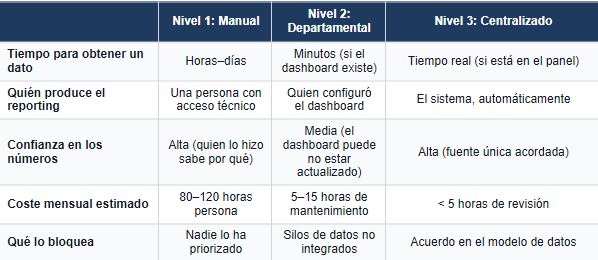
How to go from Level 1 to Level 2 in less than three months
The jump from Level 1 to Level 2 does not require a large digital transformation program or projects of more than a year. In practice, it depends on three specific decisions that few companies make together and in the right order.
Decision 1. Identify the five indicators that truly guide decisions
The starting point is not to build a scorecard with dozens of KPIs, but to identify the few — usually no more than five — that actually influence decision-making.
They are those that, if available in real time, would change the speed or quality of steering decisions. The key is not quantity, but relevance: a panel with five well-chosen indicators is much more useful than one with twenty that no one consults.
Decision 2. Connect the data sources for these indicators
Once the indicators have been defined, the next step is to understand where each one comes from.
The margin can be in the ERP, the pipeline in the CRM, the stock in the warehouse system. This exercise narrows down the problem: it is no longer a matter of integrating all the systems, but of connecting the few sources that power these indicators.
This limited scope is what allows the project to be executed in weeks instead of months.
Decision 3. Choosing a tool and committing to it
Power BI, Tableau or Looker Studio can solve this level of need. The difference between tools is less relevant than the decision to move forward.
In many companies, the blockade is not technological, but decisional. Tools are evaluated for months without implementing any, while manual work continues to accumulate.
That cost is tangible: tens of hours a month spent producing information that could be automatically available. [5]
The level jump is not technological.
It's a matter of focus, scope and decision.
The most revealing indicator: How long it takes for your company to answer a business question
There is a simple way to measure a company's level of data maturity, without diagnostics or frameworks: observe how long it takes to answer a basic business question.
If the CEO asks what the operating margin was last month by line of business, the response time says it all.
When the answer is available in minutes, on an accessible dashboard, the company has already passed the most basic level.
When it requires asking someone else and waiting for hours or days, reporting is still manual.
And when it depends on who's available or what version of the data is up to date, the problem isn't just one of tools, but one of operational dependency.
This difference has a direct impact on the business. McKinsey documents that companies with greater data maturity are 23% more likely to acquire customers, 6% more retention, and 19% more profitability. [8]
The advantage isn't in having more data.
You can use them when it matters.
Because a decision made on time isn't the same decision made days later.
References
[1] MIT Sloan Management Review. (2025). Becoming a Data-Driven Organization: The 2025 State of Analytics. WITH SMR.
Only 33% of organizations describe themselves as genuinely data-driven in 2025. The report distinguishes between organizations that use data to justify decisions already made (65%) and those where data guides the decision before making it (33%).
[2] Gartner. (2024). Data & Analytics Summit: Key Findings 2024. Gartner Research.
65% of organizations use data selectively to justify decisions already made. Only 29% can evaluate data quickly enough to stay competitive. Late reporting represents an estimated loss of between 5% and 10% of potential revenues.
[3] SaasWorthy/multiple sources. (2024). Top 50 ERP Statistics That Will Define 2025.
https://www.saasworthy.com/blog/top-erp-statistics
65% of users consider it difficult to access their own data within the ERP. Only 23% have access to real-time data and 11% believe that their ERP captures all the non-financial information needed to monitor operational KPIs.
[4] MuleSoft (Salesforce). (2024). 2024 Connectivity Benchmark Report.
https://www.mulesoft.com/connectivity-benchmark
68% of organizations identify data silos as their main strategic concern. 80% of IT leaders say that they hinder digital transformation.
[5] FSN Research/Gary Simon. (2023). Why Spreadsheets Are Still Filling the Reporting Gap. FSN.
http://www.fsn.co.uk
Financial teams spend more time collecting and verifying data than analyzing it. In medium-sized companies, this means between 80 and 120 hours per month in manual reporting (≈ €2,000—€3,500 per month in the cost of qualified personnel).
[6] ONTSI/Red.es. (2024). Digital technologies in the company 2023. National Observatory for Technology and Society.
https://www.ontsi.es/es/publicaciones/tecnologias-digitales-en-la-empresa-2023
Only 13.9% of Spanish companies analyze big data in a systematic way. 74.2% of SMEs have a basic level of digital intensity and only 26% of medium-sized ones have good digital health.
[7] IDC. (2024). The Cost of Disconnected Data in the Enterprise. IDC Research.
Organizations with siloed data lose between 20% and 30% of their productivity in inefficiencies. The cost of poor data quality in medium-sized companies is between €500,000 and €2M per year.
[8] McKinsey & Company. (2024). The Data-Driven Enterprise of 2025. McKinsey Global Institute.
Companies in the top quartile of data maturity are 23% more likely to acquire customers, 6% more retention, and 19% more profitability. The difference is not in access to data, but in the speed and quality of use.
[9] Research Window. (2023). Office of Finance Benchmark Research. Quoted in SaasWorthy (2024).
Only 11% of companies believe that their ERP captures all the necessary non-financial information. 72% of midsize companies use spreadsheets as their primary reporting tool.
[10] Gartner. (2024). Magic Quadrant for Analytics and Business Intelligence Platforms. Gartner Research.
The global BI market reached between $30,100M and $34,800M in 2024 and is projected to reach $56,280M in 2030 (CAGR 8.17%). The democratization of data is the main trend.
[11] McKinsey & Company. (2025). A New Future of Work: The Race to Deploy AI and Raise Skills in Europe and Beyond. McKinsey Global Institute.
Employees waste 9 to 10 hours a week searching for information and coordinating. 45% of that time could be eliminated with centralized data architectures.
Heading
Lorem ipsum dolor sit amet, consectetur adipiscing elit. Suspendisse varius enim in eros elementum tristique. Duis cursus, mi quis viverra ornare, eros dolor interdum nulla, ut commodo diam libero vitae erat. Aenean faucibus nibh et justo cursus id rutrum lorem imperdiet. Nunc ut sem vitae risus tristique posuere.

Artículos destacados
Explora nuestros últimos artículos y tendencias.