Retool has been solving a very specific problem since 2017: the one that appears in almost any conversation with an operations manager when he explains why his team continues to use Excel to manage processes that should be in an application.
Corporate systems don't cover that process.
The IT team doesn't have the capacity to build a customized solution.
And external development takes months and costs more than the problem justifies.
That's where Retool comes in.
The platform offers an editor drag-and-drop to build dashboards, administration panels and internal tools connected directly to databases and APIs. Today, it has more than 10,000 client companies, including Amazon, Stripe, Mercedes-Benz and the NFL, and reached ARR's 120 million dollars in October 2025. [2] Its valuation is around 3.2 billion.
And yet, many mid-sized companies continue to commission these tools from outside consultants.
This article is not a criticism of Retool — it's a solid platform in the right context.
It's an analysis of who it was really designed for... and where its scope ends in practice.
What Retool Does (and Does It Right)
Retool is not an ERP or a generalist tool. It is an accelerated development platform designed for technical profiles who need to build internal tools quickly. [9]
Its value proposition is very specific: reducing the time between need and solution.
Instead of developing an administration panel in React from scratch — a process that can take weeks — a developer can build it in hours connecting visual components to SQL queries and APIs.
That is their strong point.
The tools that best fit Retool are those that operate directly on existing data: dashboards connected to production databases, administration panels for managing users or orders, forms with validation and permission control, and internal workflows where there is human intervention —review, approve, reject—.
In such cases, the time savings are significant.
The Harmonic example illustrates this well: it built 33 internal applications in Retool, replacing a SaaS tool that costs $20,000 annually. [8]
In addition, data from the market itself points in the same direction. According to the survey Build vs. Buy of Retool (2026), with 817 participants, 78% of teams plan to build more internal tools, and 35% have already replaced at least one SaaS tool with their own development. [1]
The trend is clear: more and more companies prefer to build their own tools when the standard doesn't fit.
And Retool is well-positioned for that change.
The gap that Retool doesn't close on its own
It requires one developer to build it and another to maintain it
Retool doesn't try to hide it: it's a platform designed for developers. [7] Its proposal is not to eliminate the technical layer, but to make it faster.
For a profile that understands SQL, APIs and data logic, Retool radically reduces development time. It allows you to build in hours what used to take weeks.
But that efficiency has one condition: that profile must exist.
For the rest of the organization—operations, sales, business—the tool is not directly usable at the construction level. It is consumable, but not editable without intermediation. And that defines the adoption model.
According to Gartner, 80% of low-code platform users in 2026 will be profiles outside of IT. [5] Retool is not designed for that 80%, but for the technical 20% who build tools for others.
This means that every relevant change is still dependent on IT.
It is not a problem of the capacity of the tool, but of whom it is aimed at.
Portability and vendor lock-in
The second limit doesn't appear at the beginning. It appears when the tool is already integrated into the operation.
Applications built on Retool are not portable as standard code. If the company decides to change platforms — due to cost, strategy or security requirements — the applications must be rebuilt.
As long as the number of tools is low, this is acceptable.
When it grows—as in the case of companies that have built dozens of internal applications—it ceases to be a technical decision and becomes a complete migration project. [8]
Retool offers deployment on-premise in your Enterprise plan, which covers the data sovereignty requirement. But it doesn't change the nature of the system: logic continues to live within a proprietary environment.
Cost Scales with End-Users, Not Just Builders
The third point is the cost model.
Retool charges both for the users who build and for those who use the tools. In the Business plan, the cost is $50/month per standard user and $15/month per end user. [6]
In small teams, this isn't a problem.
But in organizations where an internal tool is used by tens or hundreds of people, the model changes.
A tool can justify the cost.
A set of tools—10, 15, or more—begins to generate a significant cost structure.
And at that point, the conversation ceases to be about productivity and becomes about architecture: whether it makes more sense to continue building within Retool or to move that development to another model where the cost does not depend on the number of end users.
Retool vs. customized internal tool: when each option is appropriate
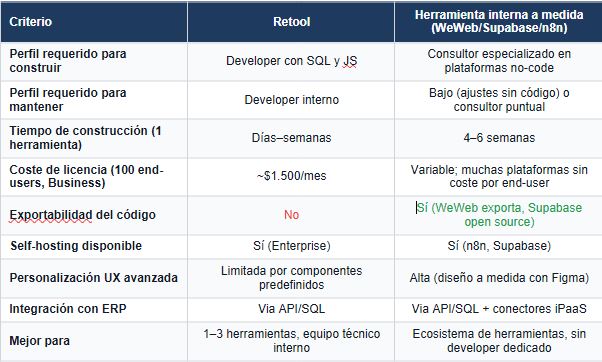
Why consulting still makes sense even though Retool exists
According to Contrary Research's analysis, Retool's main competitor is not another low-code platform, but React. [4] This comparison is more relevant than it seems, because it defines quite precisely the type of problem Retool is designed to solve.
When a company has a technical team capable of developing internal tools from scratch, Retool acts as an accelerator: it allows you to build in hours what used to require days or weeks. In this context, it does not replace development, but rather it optimizes it.
But many midsize companies don't operate in that scenario. Either they don't have developers, or they do, but their time is allocated to initiatives that directly impact the product or infrastructure. Internal tools—those that use operations, finance, or business teams—fall outside that priority.
This mismatch between what the business needs and what the technical team can address is structural. 80% of IT leaders point to data silos as one of the main obstacles to their digital transformation. [11] In practice, this translates into an accumulation of operational processes that are not well resolved and that end up being managed with improvised solutions.
It is in this space that the specialized consultant appears.
It doesn't compete with the IT team, because it doesn't work on the same problems. It intervenes precisely where IT has no capacity or cannot prioritize. It uses tools like Retool, WeWeb, Bubble or Xano, but it doesn't rely on them as a value proposition.
The difference is in the approach.
While the platform provides the building blocks, the consultancy firm defines what needs to be built, how it should work and how it fits into the company's real operations. The value is not in the tool, but in the diagnosis of the process, in the design of the solution and in the ability to deliver something that works in production right from the start.
Because that's the key point: no platform, by itself, guarantees that what is built will be useful, maintainable or adopted by the team.
The tools have reduced the technical barrier.
But they haven't eliminated the need for design.
References
[1] Retool. (2026, February). The Build vs. Buy Shift: How Vibe Coding and Shadow IT Have Reshaped Enterprise Software. Retool Research (survey of 817 participants in autumn 2025). BusinessWire.
https://www.businesswire.com/news/home/20260217548274/en/Retools-2026-Build-vs.-Buy-Report
— 78% of teams plan to build more internal tools by 2026. 35% have already replaced at least one SaaS tool with their own development. 60% built software outside of IT oversight in the past year
[2] Sacred Research. (2025). Retool Revenue, Valuation & Funding.
https://sacra.com/c/retool/
— Retool reached $120M in ARR in October 2025 (+39% YoY from $90M in 2024). Valuation: $3.200M (Series C, July 2022, Sequoia Capital). Customers: Amazon, Stripe, Mercedes-Benz, NFL, NBC, Rakuten, Brex, Lyft, DoorDash.
[3] Gartner. (2026). Retool Reviews and Ratings. Gartner Peer Insights.
https://www.gartner.com/reviews/market/enterprise-low-code-application-platform/vendor/retool/product/retool
— 183 verified reviews. 50M—250M USD companies highlight rapid prototyping and learning curve.
[4] Contrary Research. (2024). Retool Business Breakdown & Founding Story.
https://research.contrary.com/company/retool
— Growth from $10M ARR (2020) to $80M (2022). More than 500,000 apps built. Main competitor: React.
[5] ToolJet. (2026, February). Complete Guide to Internal Tools 2026.
https://blog.tooljet.com/complete-guide-to-internal-tools/
— By 2026, 80% of low-code users will be non-IT profiles. Projected market: from $45,500M (2025) to ~$188,000M (2030).
[6] Retool. (2026). Pricing.
https://retool.com/pricing
— Free: up to 5 standard users.
— Team: $10/standard user/month + $5/end-user.
— Business: $50/standard user/month + $15/end-user.
— Enterprise: custom pricing (SSO, audit logs, on-premise, SLA, support).
[7] Sacred Research. (2025). Retool vs. Replit.
https://sacra.com/research/retool-vs-replit/
— Retool is aimed at developers. Emerging competition: vibe coding tools (Cursor, Claude Code).
[8] Retool. (2026). Build vs. Buy Report 2026. Op. cit.
— Harmonic replaced a $20,000/year SaaS tool with Retool. It operates 33 internal apps connected to multiple systems.
[9] Gartner. (2024). Magic Quadrant for Enterprise Low-Code Application Platforms.
— Retool is positioned as an accelerated development platform for technical profiles, differentiated from tools for citizen developers.
[10] PitchBook. (2026). Retool Company Profile.
https://pitchbook.com/profiles/company/185237-38
— $190M raised. 471 employees (January 2026). $45M Series C with existing inverters.
[11] MuleSoft (Salesforce). (2024). 2024 Connectivity Benchmark Report.
https://www.mulesoft.com/connectivity-benchmark
— 80% of IT leaders point to data silos as the main obstacle. Internal tools are out of priority.
Heading
Lorem ipsum dolor sit amet, consectetur adipiscing elit. Suspendisse varius enim in eros elementum tristique. Duis cursus, mi quis viverra ornare, eros dolor interdum nulla, ut commodo diam libero vitae erat. Aenean faucibus nibh et justo cursus id rutrum lorem imperdiet. Nunc ut sem vitae risus tristique posuere.

Artículos destacados
Explora nuestros últimos artículos y tendencias.