The statistic is so often cited that it has lost its capacity for impact: 64% of ERP projects exceed the initial budget and 75% exceed the original deadline. [1]
What is least cited is the analysis of the other side of the distribution: the 36% that ends within time and budget. What do they do differently?
Panorama Consulting, which has been analyzing ERP implementations in medium-sized companies for two decades, identifies the lack of definition of scope as the main factor of deviation. Not the technical problems of the platform. Not software bugs. The lack of definition of what the ERP will do and, above all, of what it will not do. [1]
Implementations that end on time and budget have something in common: they precisely delimit the processes that the ERP will not cover and they have a plan to cover them in another way.
This article analyzes that side of statistics. Not failure, but the anatomy of success in mid-market ERP implementations: what previous decisions make the difference, why ERP can't cover everything by design, and what role complementary tools play in projects that end well.
Why ERP can't cover everything (and it was never designed for it)
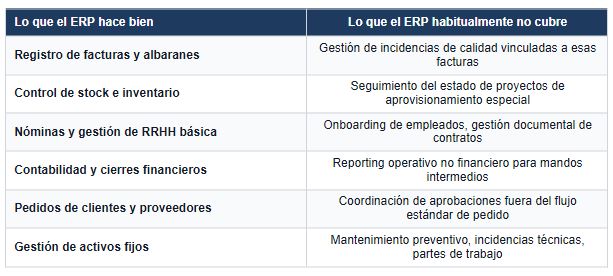
ERP is, by definition, a transactional record system. It is designed to capture, process and store the financial and operational transactions that define the legal and accounting status of the company: invoices, orders, delivery notes, payroll, accounting entries.
That's what it does well. What it doesn't do well — because it wasn't designed for it — are the non-transactional operational processes that surround and fuel those transactions.
78% of organizations consider that their ERP covers less than 70% of their real operational needs. [4] 34% identify that the gap is mainly generated in non-transactional processes: the management of quality incidents, the coordination of internal projects, the approval of expenses outside the standard flow, the monitoring of operational indicators that the ERP does not capture, structured communication with suppliers or the management of documents linked to orders.
This is not a limitation of ERP: it is its definition. A system designed to be the company's financial record cannot also be the incident management system, the supplier portal, the project tracker and the operational KPIs panel. The problem isn't the ERP. It is to hope that it is everything.
The market direction is clear: SAP is migrating its installed base to S/4HANA Cloud and BTP, and iPaaS manufacturers are investing in certified connectors for that architecture. For companies that are already in S/4HANA Cloud, integration with tools such as n8n or Make will be progressively more accessible.
For those who are still operating in ECC or Business One, the path goes through one of the four scenarios described above.
What differentiates the 36% who don't go over budget
Panorama Consulting identifies three factors that systematically distinguish successful ERP implementations from those that deviate: [1]
1. Explicit definition of negative reach
The positive scope of an ERP project — what modules are going to be implemented, what processes are going to be covered — is always documented. What distinguishes projects that end well is that they also document the negative scope: which operational processes are explicitly left out of the ERP and how they are going to be covered.
This decision eliminates the main source of scope creep: users who, during implementation, discover that the ERP does not cover a process they need and request customizations to cover it. The customization of the ERP for non-transactional processes is, in a systematic way, the most common cause of budgetary deviation.
An ERP with a lot of customizations is also an ERP that is more difficult to update, more expensive to maintain, and more dependent on the implementation vendor.
2. Parallel plan for processes that are left out
77% of midsize companies don't use the workflow management features of their ERP. [9]
Part of this statistic reflects workflows that ERP has but that users don't adopt because the user experience is poor. Another part reflects processes that the ERP simply cannot manage well.
Successful implementations have a plan for these processes before go-live. Not a “we'll figure it out later”, but an explicit decision: this process will be covered with a specific tool, with this design and with this manager, before the ERP goes into production.
This tool can be a custom-built no-code application, a project management platform configured for the specific use case, or an automation that connects the ERP to the system where that process can be managed well.
3. Data architecture from the start, not like afterthought
65% of users consider it difficult to access their own data within the ERP. [5]
This isn't just a UX problem: it's a data design problem. Implementations that end up on budget define from the outset how data will be extracted from the ERP for reporting, which data will live in the ERP and which in complementary systems, and how both will be synchronized.
A reporting or BI layer that is not designed during the implementation of the ERP is then added as an additional project, with the complexity of working on an already fixed data structure that may not have been designed to facilitate extraction.
This additional project is an unbudgeted cost that appears between six and eighteen months post-go-live.
The model that reduces risk: ERP for the transactional, satellites for the operational
The model that characterizes successful mid-market ERP implementations in the last five years has a name that has become popular among technology consultancies: satellite tools.
The ERP maintains its role as a central record system for standard financial and operational transactions. Satellite tools cover non-transactional operational processes that ERP cannot manage well without costly customization.
Low-code and iPaaS platforms have made this model accessible to midsize businesses. The average implementation time of a satellite tool via a low-code platform is 4—6 weeks. The average equivalent customization time in the ERP is 3—9 months. [6]
The difference in cost is proportional. And the satellite tool does not add technical debt to the core of the ERP: it can be replaced without affecting the central system.
By 2026, Gartner projects that 75% of new business applications will be built with low-code or no-code platforms. [7] The ERP core + specific satellites pattern is not a compromise solution: it is the emerging technological architecture from the mid-market, which separates the registration system from the work systems.
The most honest positioning is not a replacement for ERP. The medium-sized company already has its financial system and changing it is a 12-18 month project that no organization undertakes without compelling reasons.
It's about covering the 20— 30% that system was never designed to solve. The company that understands this distinction invests better and expects more realistic results.
What is worth calculating before starting any ERP project
The cost of ownership of an ERP in the mid-market represents between 3% and 5% of annual turnover. [3] For a company with €30 million in turnover, that equates to between €900,000 and €1.5 million per year in licenses, maintenance, support and adjustments. It's a significant investment for any company of that size.
Before committing that investment, there are three calculations that successful implementations do systematically and that failed implementations rarely rigorously address:
The inventory of non-transactional processes
What company operating processes do not fit into the ERP transactional model, how much time they currently consume and how they will be resolved if they are not included in its scope. Without this inventory, the Scope Creep it's unavoidable.
The cost of post-ERP reporting
The new ERP will have better data than the previous one, but that data must reach decision makers in a usable format. The design of the reporting—who needs it, in what format and how often—that is not carried out during implementation becomes an additional project six to eighteen months later.
The Organizational Change Budget
Panorama Consulting identifies the lack of change management as the second factor of failure, after the lack of definition of the scope. [1]
A new ERP changes the workflows of all users. Training, internal communication and support during the first months after Go-live they have a cost that is often underestimated or eliminated in budgetary revisions.
The consulting firm that comes in after the ERP, not instead of it
The satellite tool model has a direct implication for the type of consulting that a medium-sized company needs. The ERP vendor—SAP, Microsoft, Oracle, Sage—is responsible for the central system. Consulting that covers the processes that are left out does not compete with ERP: it complements what ERP does not do.
This position is strategically different from that of a traditional ERP integrator. The integrator works within the system. The satellite tool consultant works in the space between systems: the operational gap that the ERP doesn't fill, the processes that employees solve with spreadsheets, the approval workflows that circulate via email, and the reports that someone builds manually every month because the ERP doesn't generate them in the format that needs direction.
Forrester estimates a three-year ROI of 248 percent for organizations that successfully fill those gaps with automation and low-code tools. [11]
Only 26% of medium-sized Spanish companies currently have good digital health. [8] The gap between potential and reality is the space where the greatest value is produced.
References
1. Panorama Consulting Group. (2024). 2024 ERP Report. Panorama Consulting. https://www.panorama-consulting.com/resource-center/erp-report/ —64% of ERP projects exceed the initial budget. 75% exceed the original deadline. The average implementation time in the mid-market is 14.3 months. The most cited cause of deviation is the undefined scope (scope creep) during the design phases.
2. Gartner. (2023). ERP in the Midmarket: Why Implementations Fail and How to Succeed. Gartner Research (ID: G00789124). Gartner estimates that between 55% and 75% of ERP projects are considered partial failures by the users themselves upon completion, measured by the gap between initial expectations and final result. The root cause identified is the underestimation of processes that ERP cannot cover by design.
3. IDC. (2024). The Cost of Disconnected Data in the Enterprise. IDCSearch. The mid-market ERP cost of ownership (100—999 employees) represents between 3% and 5% of annual turnover. For a company with €30M in turnover, that equates to between €900,000 and €1.5M per year including licenses, maintenance, support and adjustments.
4. Deloitte. (2023). 2023 Global ERP Survey. Deloitte Insights. https://www.deloitte.com — 78% of organizations believe that their current ERP covers less than 70% of their real operational needs. 34% identify that the gap is mainly generated in non-transactional operational processes that the ERP was not designed to manage.
5. SaaSworthy/ multiple compiled sources. (2024). Top 50 ERP Statistics That Will Define 2025. https://www.saasworthy.com/blog/top-erp-statistics — 65% of users consider it difficult to access their own data within the ERP. Only 23% have access to real-time data. Only 11% believe that their ERP captures all the non-financial information needed to monitor operational KPIs.
6. MuleSoft (Salesforce). (2024). 2024 Connectivity Benchmark Report. MuleSoft. https://www.mulesoft.com/connectivity-benchmark — Low-code and iPaaS platforms reduce integration development time by 50% to 90% compared to traditional methods. The average implementation time via iPaaS is 2—6 weeks compared to 3—9 months via custom development.
7. Gartner. (2024). Predicts 2026: Low-Code and No-Code Application Platforms.Gartner Research. By 2026, 75% of new business applications will be built with low-code or no-code platforms. The European market for low-code platforms will increase from $2,920 million in 2024 to $17,310 million in 2033 (CAGR 22%).
8. ONTSI/ Red.es. (2024). Digital technologies in business 2023. National Observatory for Technology and Society. Only 26% of medium-sized Spanish companies have good digital health. The Digital Kit (Royal Decree-Law 36/2020) offers grants of up to €29,000 per company for digitalization.
9. ERP News. (2024). Electronic Workflow Process Gaps Kill an Estimated 20% of ERP Productivity. ERP News. 77% of medium-sized companies do not use the workflow management features of their ERP. Between 15% and 20% of the potential value of ERP is lost through non-digitized approval and coordination processes.
10. FSN Research/Gary Simon. (2023). Why Spreadsheets Are Still Filling The Reporting Gap. FSN. http://www.fsn.co.uk — Finance teams spend more time collecting and verifying ERP data than analyzing it. Only 11% of companies believe that their ERP captures all the non-financial information needed for their KPIs.
11. Forrester Research. (2024). The Total Economic Impact™ Of Microsoft PowerAutomate. Forrester Consulting. https://tei.forrester.com/go/microsoft/powerautomatetei/index.html —ROI of 248 percent over three years for successful implementations. The payback period is less than six months in the organizations analyzed.
Heading
Lorem ipsum dolor sit amet, consectetur adipiscing elit. Suspendisse varius enim in eros elementum tristique. Duis cursus, mi quis viverra ornare, eros dolor interdum nulla, ut commodo diam libero vitae erat. Aenean faucibus nibh et justo cursus id rutrum lorem imperdiet. Nunc ut sem vitae risus tristique posuere.

Artículos destacados
Explora nuestros últimos artículos y tendencias.